GTS Overview
The Geospatial Tracking System (GTS) is designed to be intuitive and to promote capacity building and empowerment of those managing field activities.
Once an Organization has been created in the GTS and a Focal Point assigned, the organization’s Focal Point is free to manage all aspects of their GTS instance without any dependency on external parties.
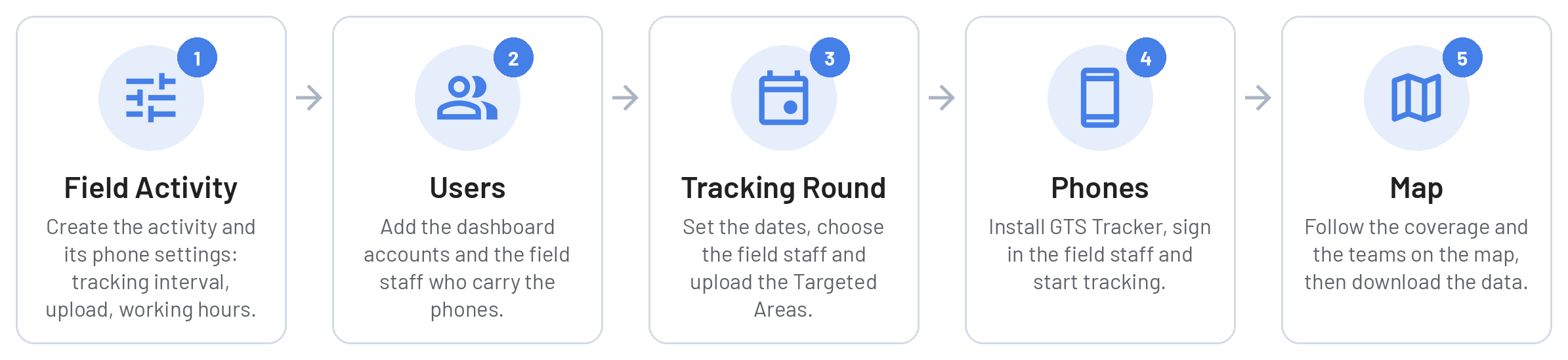
From a new Organization to the map in five steps, detailed in the Quick Start Guide.
GTS Components:
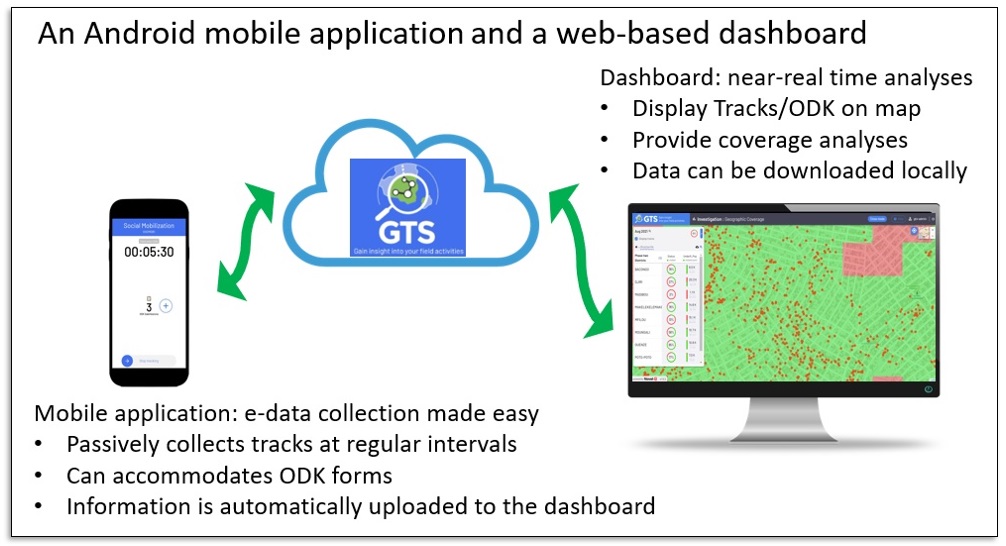
The GTS employs Android smartphones to collect data in the field and a cloud-based central server to manage activities, display data on maps and permit downloading of datasets for further analysis.
Android Mobile Application for tracking field staff activities.
Online Dashboard for Administration and Map Analysis.
GTS can also receive tracks from NtDot hardware trackers and from other external devices, which are monitored in the same way as phones (see the Device Monitoring tab of the Tracking Round Level).
Mobile Applications
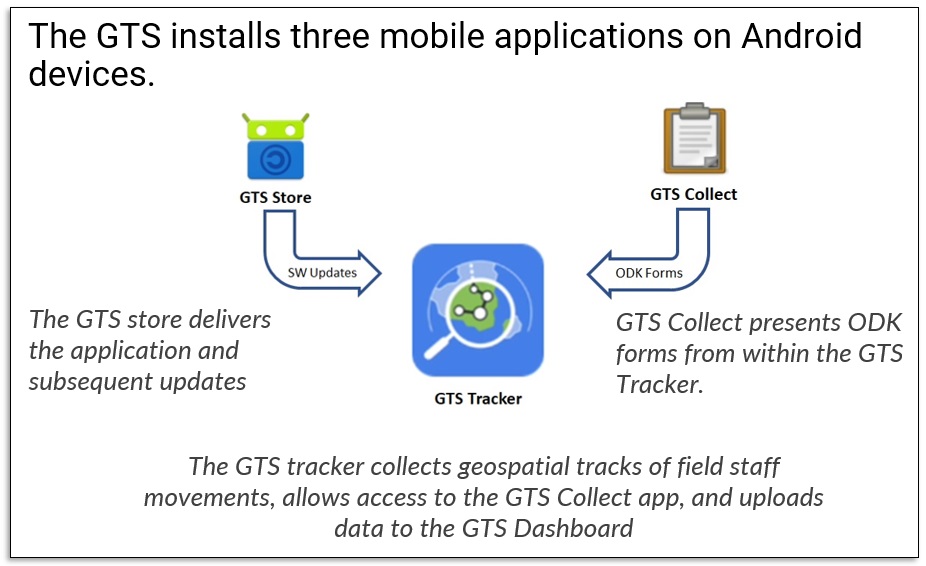
GTS Tracker The mobile tracking application is an intuitive easy-to-use tracking application that requires little or no field staff training nor manipulation. It constantly records geospatial coordinates based on dashboard configured interval and operating hour parameters to ensure accuracy and completeness of field activity tracking.
GTS Collect The GTS Collect is embedded in the GTS Tracker and can accommodate ODK Collect forms to capture and upload contextual data during field activities.
GTS Store The GTS Store is the app store used for the digital distribution and automatic updates of the GTS Mobile Application components.
Central Dashboard
The GTS Dashboard includes an Administration Console to configure an Organization’s GTS instance and a Map Display Console to view Field Activity geo-spatially, view aggregated analysis, and download data for further processing.
Administration The GTS Server enables the creation and management of Organizations, Users, Field Activities and Field Staff accounts.
Display The GTS Server enables tracking data to be shared and disseminated while provisioning for the protection of sensitive information. It displays collected tracks graphically on maps and permits the download of selected tracks, in various formats, for offline analysis.
Microplan moderation A simple web page on which health facility staff review and validate the microplan proposed by GTS (see the Microplan tab of the Tracking Round Level).
Open Data Reporting tools such as Power BI can read tracks, form submissions and indicators directly (see How to use the GTS OData API with Power BI).
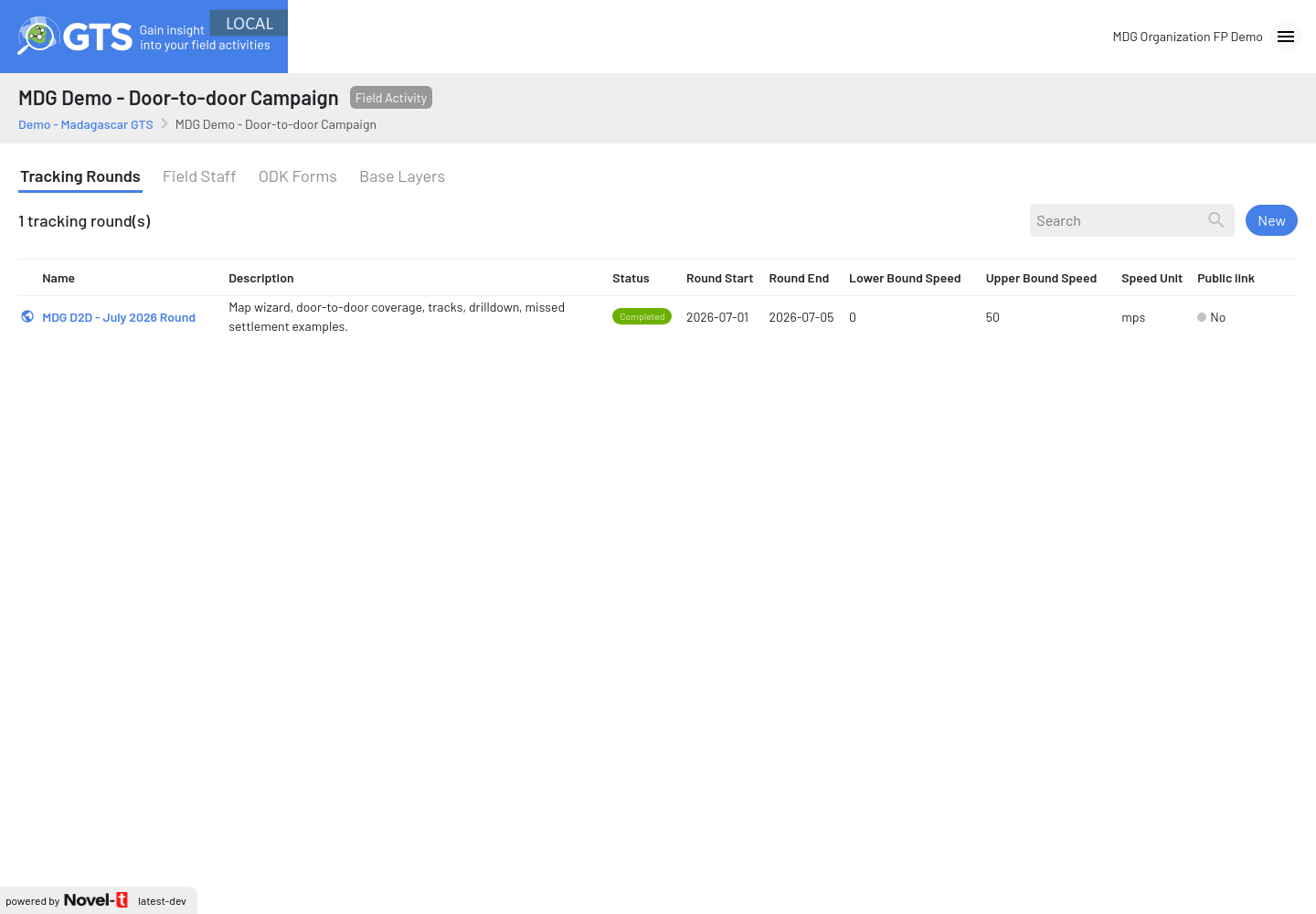
Administration Console: the Tracking Rounds of a Field Activity
How GTS is organized
Everything you configure belongs to one of three nested levels:
Organization: your GTS instance, with its dashboard accounts, field staff, ODK forms and base layers.
Field Activity (FA): an activity that field staff select in GTS Tracker (for example a vaccination campaign). It defines how tracks are collected: tracking interval, working hours, speed limits, team codes and ODK forms.
Tracking Round (TR): a time-bound instance of a Field Activity (for example Round 1, March 2026). It defines the dates, the field staff, the Targeted Areas, the indicators, the Teams Deployment and, for routine immunization, the microplan. Maps, indicators and exports are always displayed for one Tracking Round.
Where to start
I want to… |
Read |
|---|---|
Set up GTS for the first time |
|
Create accounts for colleagues and field staff |
|
Choose the role of a colleague |
|
Create a Field Activity |
|
Create a Tracking Round or share its map (public link) |
|
Upload Targeted Areas and choose the campaign strategy |
|
Prepare the shapefiles and ODK forms |
|
Connect Power BI |
The GTS User Guide explains how to use the map, the indicators and the downloads, and describes complete workflows for door-to-door, stationary and routine immunization campaigns.